How to Know If a Government Contract Is Worth Bidding: A Practical Bid/No-Bid Checklist for Small Businesses
Government contracting can create major growth opportunities for small businesses, but not every opportunity is worth pursuing.
Many small businesses see a federal solicitation, notice the contract value, recognize the agency name, and immediately start building a proposal. The problem is that bidding without a structured review can quickly waste time, money, and internal resources.
A strong Bid/No-Bid decision process helps your business decide whether an opportunity is a strategic fit before your team invests hours into proposal development.
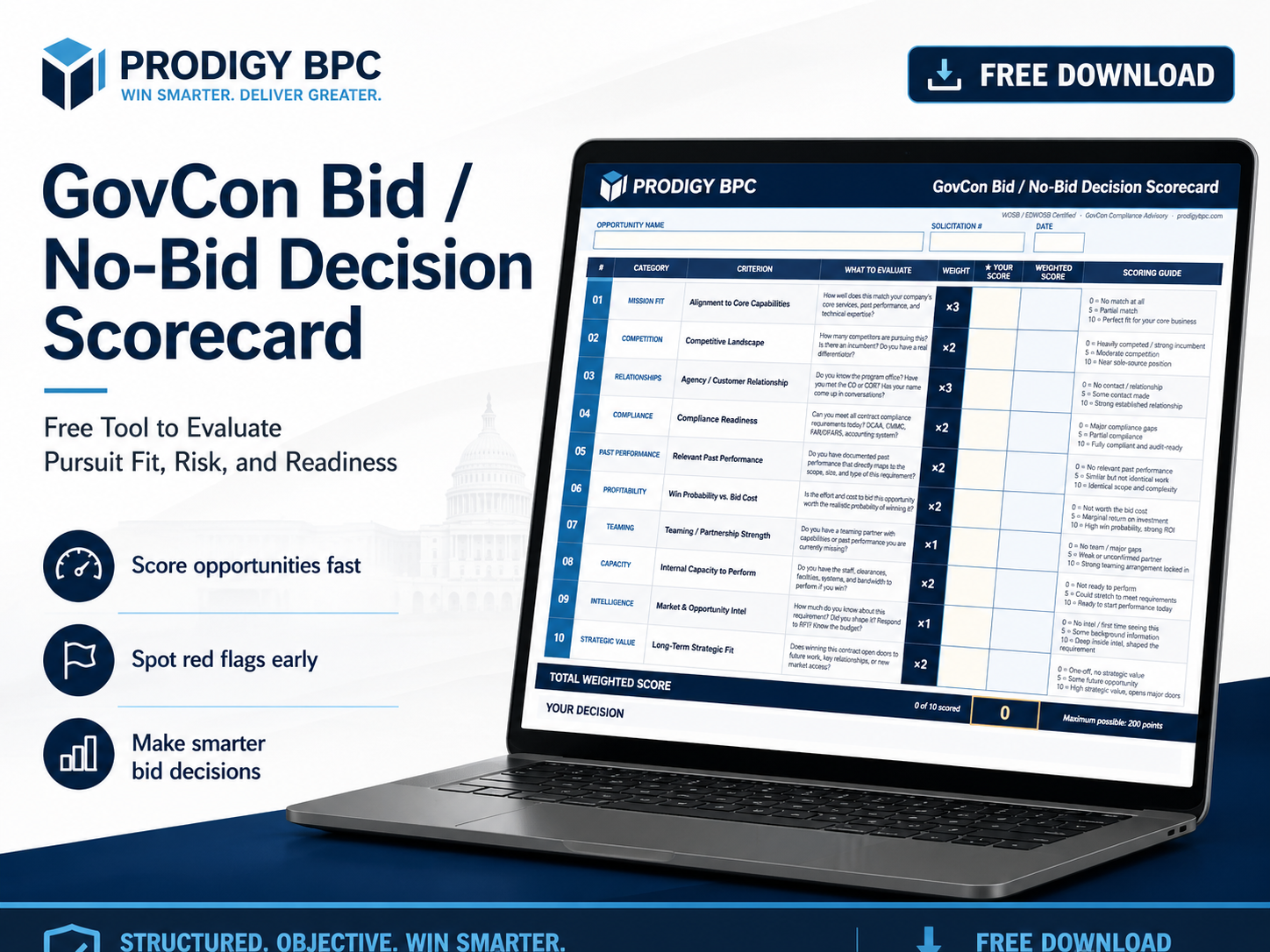
At Prodigy BPC, we created a free resource to help small businesses make better pursuit decisions:
Download the Free GovCon Bid/No-Bid Decision Scorecard
Why Small Businesses Need a Bid/No-Bid Process
A government proposal is not just an application. It is a compliance-driven business decision.
Before pursuing a federal opportunity, small businesses should evaluate whether they have the right capabilities, past performance, pricing strategy, staffing, certifications, and time to submit a compliant and competitive proposal.
Without a structured checklist, businesses often bid because:
They want revenue quickly.
The opportunity looks close to their services.
The contract value is attractive.
The agency seems familiar.
They assume they can “figure it out” during the proposal process.
But a poor-fit pursuit can pull leadership, operations, pricing, and technical staff away from better opportunities. Even worse, a rushed or noncompliant proposal can damage credibility with agencies, primes, and teaming partners.
What Is a Bid/No-Bid Checklist?
A Bid/No-Bid checklist is a structured evaluation tool used before proposal kickoff. It helps determine whether your company should pursue, pause, partner, or decline an opportunity.
The checklist helps answer critical questions such as:
Does this opportunity align with our core capabilities?
Do we meet the set-aside, certification, and eligibility requirements?
Do we have relevant past performance?
Can we staff and price the work competitively?
Do we understand the customer and buying environment?
Can we meet all compliance and submission requirements?
Do we have enough time to develop a quality proposal?
Is there a realistic probability of win?
The goal is not just to ask, “Can we bid?”
The better question is: Should we bid, and can we win?
Key Areas to Review Before Bidding
1. Opportunity Fit
Start by reviewing whether the scope of work aligns with your company’s actual capabilities.
A good-fit opportunity should connect clearly to your services, experience, past performance, and available resources. If the requirement is outside your core business, you may need a teaming partner — or you may need to walk away.
Ask yourself:
Can we perform the work?
Have we done similar work before?
Does this opportunity support our long-term business strategy?
Would this contract strengthen our past performance?
2. Compliance Requirements
Government solicitations often include detailed instructions, mandatory forms, formatting rules, page limits, certifications, and submission requirements.
Missing one requirement can make a proposal nonresponsive.
Before deciding to bid, review:
Proposal instructions
Evaluation criteria
Required forms and attachments
Certifications and representations
Security or clearance requirements
Page limits and file naming rules
Submission portal instructions
Due dates and Q&A deadlines
A compliance review should happen before writing begins — not the night before submission.
3. Past Performance Strength
Past performance is one of the strongest indicators of whether your company can compete.
Even if your company can technically perform the work, the agency may want proof that you have successfully delivered similar services.
Review whether your company has:
Similar contracts or projects
Relevant customer references
Comparable scope, size, and complexity
Strong performance outcomes
Documented results or metrics
If your past performance is weak, teaming may be the better path.
4. Pricing and Staffing Readiness
Many small businesses focus on the technical response but underestimate pricing and staffing.
Before bidding, determine whether you can support:
Required labor categories
Competitive rates
Key personnel requirements
Location or travel needs
Period of performance
Surge support or transition timelines
Subcontractor pricing, if applicable
A strong proposal needs both a compelling technical approach and a realistic price strategy.
5. Proposal Timeline
A short deadline is not always a reason to no-bid, but it does increase risk.
If the due date is close, ask:
Do we have enough time to read the solicitation?
Can we build a compliance matrix?
Can we gather resumes, past performance, and pricing?
Can leadership review the proposal before submission?
Can we complete quality control and final upload on time?
If the answer is no, the opportunity may create unnecessary risk.
6. Win Probability
A Bid/No-Bid process should help you evaluate your probability of win.
This includes reviewing:
Customer relationship
Incumbent advantage
Competitive landscape
Set-aside fit
Agency buying history
Technical differentiation
Past performance relevance
Pricing competitiveness
Teaming strength
If your only reason for bidding is “we are eligible,” that may not be enough.
Eligibility does not equal strategy.
Common Red Flags Before Pursuing a Government Contract
A structured Bid/No-Bid checklist helps identify red flags early.
Watch for:
Unclear scope of work
Unrealistic timeline
Weak past performance alignment
No customer knowledge
No pricing strategy
Missing required certifications
High compliance burden
No available staff
No teaming partner
Incumbent appears strongly positioned
Proposal requires more effort than the opportunity is worth
Red flags do not always mean no-bid. Sometimes they mean you need a partner, more capture work, or a better pursuit strategy.
How Prodigy BPC Helps Small Businesses Compete Smarter
Prodigy BPC helps small businesses strengthen their government contracting operations through compliance, proposal readiness, program controls, internal controls, audit readiness, and strategic capture support.
Our goal is to help contractors move from reactive bidding to structured, informed decision-making.
That starts with knowing when to pursue an opportunity — and when to walk away.
Download the Free GovCon Bid/No-Bid Decision Scorecard
Before your next proposal kickoff, use Prodigy BPC’s free scorecard to evaluate whether the opportunity is a strong fit, high-risk pursuit, or no-bid decision.
Download the Free GovCon Bid/No-Bid Decision Scorecard
This resource is designed to help small businesses evaluate opportunity fit, compliance risk, pricing readiness, proposal timeline, past performance alignment, and red flags before committing proposal resources.
Final Thoughts
Government contracting is not about chasing every opportunity.
It is about pursuing the right opportunities with the right strategy, the right compliance structure, and the right resources.
A strong Bid/No-Bid process helps protect your time, focus your pipeline, and increase your chances of submitting stronger proposals.
Before you bid, pause and evaluate.
The right no-bid decision can be just as valuable as the right win.